

After weeks of heavy rain, water in the basement is one of the last things any homeowner wants to see.
But once the cleanup starts, an equally important question usually follows:
“Is this covered by my homeowners insurance?”
The frustrating answer is: it depends on where the water came from.
To a homeowner, water coming through a floor drain, seeping through a basement wall, or flowing through a basement window can all look like the same problem. From an insurance standpoint, however, they can be three very different losses.
Sewer or drain backup, groundwater, and flood are not interchangeable terms—and they generally are not insured the same way.
With the amount of rain we’ve seen recently across Ohio, this is a good time to explain the differences before the next storm arrives.
First: Where Did the Water Come From?
When determining how water damage may be covered, the source of the water matters.
Imagine three homes on the same street after the same major rainstorm:
House #1: The municipal sewer system becomes overwhelmed and water backs up through the homeowner’s basement drain.
House #2: The ground becomes saturated and water seeps through cracks in the basement walls or foundation.
House #3: Heavy rain creates rapidly accumulating surface water that rises across the property and enters the house through a basement window or doorway.
All three homeowners have water in their basements.
But they may be dealing with three completely different insurance situations.
That’s why simply saying, “My basement flooded,” doesn’t tell us enough to determine whether a loss may be covered.
What Is Backup of Sewer or Drain Coverage?
Let’s start with one of the most important optional coverages homeowners should understand.
A standard homeowners policy may exclude or limit damage caused by water that backs up through a sewer or drain or overflows from a sump system. Depending on the insurance company and policy, homeowners may be able to purchase additional water backup or sewer and drain backup coverage.
For example, imagine several inches of rain fall in a short period of time.
The municipal sewer system can’t handle the volume of water, and sewage or water begins backing up through a floor drain in your basement.
That may be the type of situation where water backup coverage becomes extremely important.
Coverage varies by policy, but an endorsement may help cover resulting damage to covered property, subject to the policy’s limits, deductible, exclusions, and conditions.
FEMA also specifically notes that homeowners should discuss optional coverage for situations such as sewer backup because standard homeowners insurance and flood insurance address different types of water losses. (FloodSmart Agents)
How Much Water Backup Coverage Do You Have?
This is where homeowners need to pay attention.
Simply seeing “water backup” listed on your policy doesn’t necessarily tell you everything you need to know.
Your endorsement may have its own coverage limit, and that limit can matter tremendously if you have a finished basement.
Think about what could be downstairs:
- Flooring
- Drywall
- Furniture
- Electronics
- Appliances
- Furnaces and mechanical equipment
- Personal belongings
A few inches of water can become an expensive loss very quickly.
Instead of only asking, “Do I have water backup coverage?”, ask your agent:
“How much water backup coverage do I have, and what does my endorsement actually cover?”
That’s a much better question.
What About Groundwater Seeping Into the Basement?
This is where things get especially confusing.
After days of rain, the soil around a home can become saturated. Water may begin pushing through cracks in the foundation, basement walls, or floor.
Homeowners sometimes call this “flooding.”
Insurance policies may treat it differently.
Water below the surface of the ground that seeps or leaks through a foundation is generally not the same thing as water backing up through a sewer or drain.
That distinction matters because adding sewer and drain backup coverage does not mean you’ve purchased protection against every possible way water can enter your basement.
This is exactly why identifying the source of the water is so important.
If you’re seeing water seep through basement walls or floors during prolonged rain, you should also investigate the underlying drainage issue. Gutters, downspouts, grading, foundation drainage, sump systems, and cracks can all play a role.
Insurance can protect against certain unexpected losses, but it isn’t a substitute for correcting an ongoing water-intrusion problem.
Then What Is Considered a Flood?
This is probably the biggest misunderstanding of all.
Most homeowners use the word “flood” to describe almost any unwanted water in their home.
Insurance has a much more specific definition.
Under the National Flood Insurance Program, a flood generally involves a temporary condition where normally dry land is inundated across two or more acres or two or more properties, one of which is yours, due to causes including overflowing inland or tidal waters or unusual and rapid accumulation or runoff of surface water. (FloodSmart Agents)
Think:
Water coming across the ground and into your house.
That could happen when:
- A creek or river overflows.
- Heavy rain creates rapidly accumulating surface water.
- Water collects across multiple properties.
- Surface runoff enters a home.
And here’s the important part:
Standard homeowners insurance generally does not cover flood damage.
Flood coverage normally requires a separate flood insurance policy. FEMA specifically warns homeowners that most homeowners policies don’t cover damage caused by flooding. (FloodSmart Agents)
And you don’t necessarily need to live next to a river to have a flood exposure. FEMA reports that from 2014 through 2024, almost one-third of NFIP flood claims came from areas outside high-risk flood areas. (FloodSmart Agents)
But What If a Flood Causes the Sewer to Back Up?
Now we’re getting into one of those situations where the details really matter.
Under an NFIP flood policy, sewer or drain backup can potentially be covered when a covered flood is the direct cause of the backup. The same principle can apply to sump discharge or overflow and certain seepage when flood is the proximate cause. (FloodSmart Agents)
That’s different from a sewer backup caused by another problem.
This is why determining the cause of a water loss isn’t just insurance jargon—it can determine which policy, if any, responds to the damage.
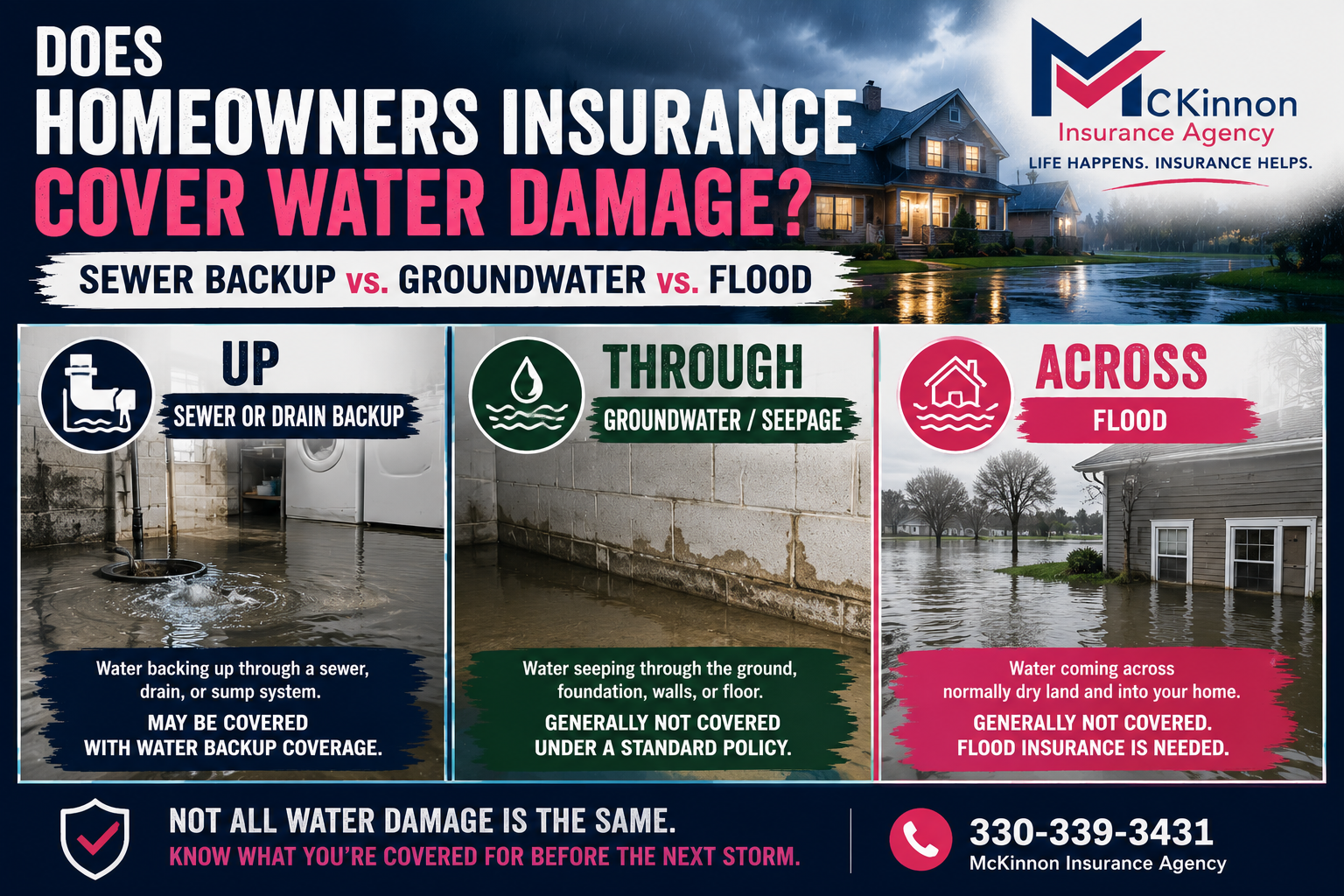
A Simple Way to Understand the Difference
Here’s how we explain it to clients:
Water comes UP through a drain or sump:
Think water/sewer backup coverage.
Water seeps THROUGH the ground, foundation, wall, or floor:
Think groundwater/seepage, which is generally a different issue and may be excluded.
Water comes ACROSS normally dry ground and enters the home:
Think flood insurance.
That’s intentionally simplified because actual coverage always depends on the facts of the loss and the language of your specific policy.
But as a starting point, UP, THROUGH, and ACROSS makes the distinction much easier to remember.
What About Rain Coming Through My Roof?
Here’s another important distinction.
Suppose a storm damages your roof and rain enters the house through the opening.
That’s not necessarily a “flood.”
FEMA distinguishes between rising or accumulating surface water and rain entering through a storm-damaged roof. The latter may potentially fall under homeowners coverage depending on what caused the opening and the terms of the policy. (FloodSmart Agents)
Again, the important question isn’t simply:
“Did water damage my house?”
It’s:
“How did the water get into my house?”
Why Finished Basements Deserve Extra Attention
If you have a finished basement, this conversation becomes even more important.
Think about how much money may be invested downstairs:
A finished family room.
Furniture.
Televisions.
Carpet or flooring.
A home office.
Kids’ rooms.
Exercise equipment.
Mechanical systems.
Storage.
A homeowner can easily have tens of thousands of dollars invested below grade.
Yet that same homeowner may have never looked at the water-related exclusions, endorsements, and limits on their policy.
Flood insurance also has important limitations for property located in basements, so homeowners shouldn’t assume purchasing a flood policy automatically provides full protection for everything they’ve put downstairs. (FloodSmart Agents)
That’s why this conversation should happen before there’s water on the floor.
Don’t Wait Until It’s Raining to Review Your Coverage
After several weeks of rain, homeowners naturally start thinking about water damage.
But the best time to understand your coverage is before the next storm.
Pull out your homeowners policy and find out:
Do I have water backup coverage?
What is my water backup limit?
Do I have a sump pump, and how does my endorsement address it?
What happens if groundwater enters my basement?
Do I have flood insurance?
How much property do I have in my basement?
Those questions are much more valuable than simply asking whether you have “good homeowners insurance.”
The Bottom Line: Not All Water Damage Is the Same
A basement full of water is a basement full of water to the homeowner cleaning it up.
To an insurance policy, how that water got there can make all the difference.
Remember:
UP = Sewer or drain backup
THROUGH = Groundwater/seepage
ACROSS = Flood
There are exceptions and policy-specific details, but understanding those three categories gives homeowners a much better starting point.
At McKinnon Insurance, we’d much rather have this conversation with you before the next heavy rain than after you’re standing in a wet basement wondering whether you’re covered.
If you’re unsure what your homeowners policy says about water backup, sump overflow, groundwater, or flood, give our team a call at 330-339-3431.
We’ll help you look at what you have, explain it in plain English, and identify questions or gaps worth discussing.
Because understanding your insurance before you need it is always better than finding out afterward.
Life Happens. Insurance Helps.


Leave a Reply