

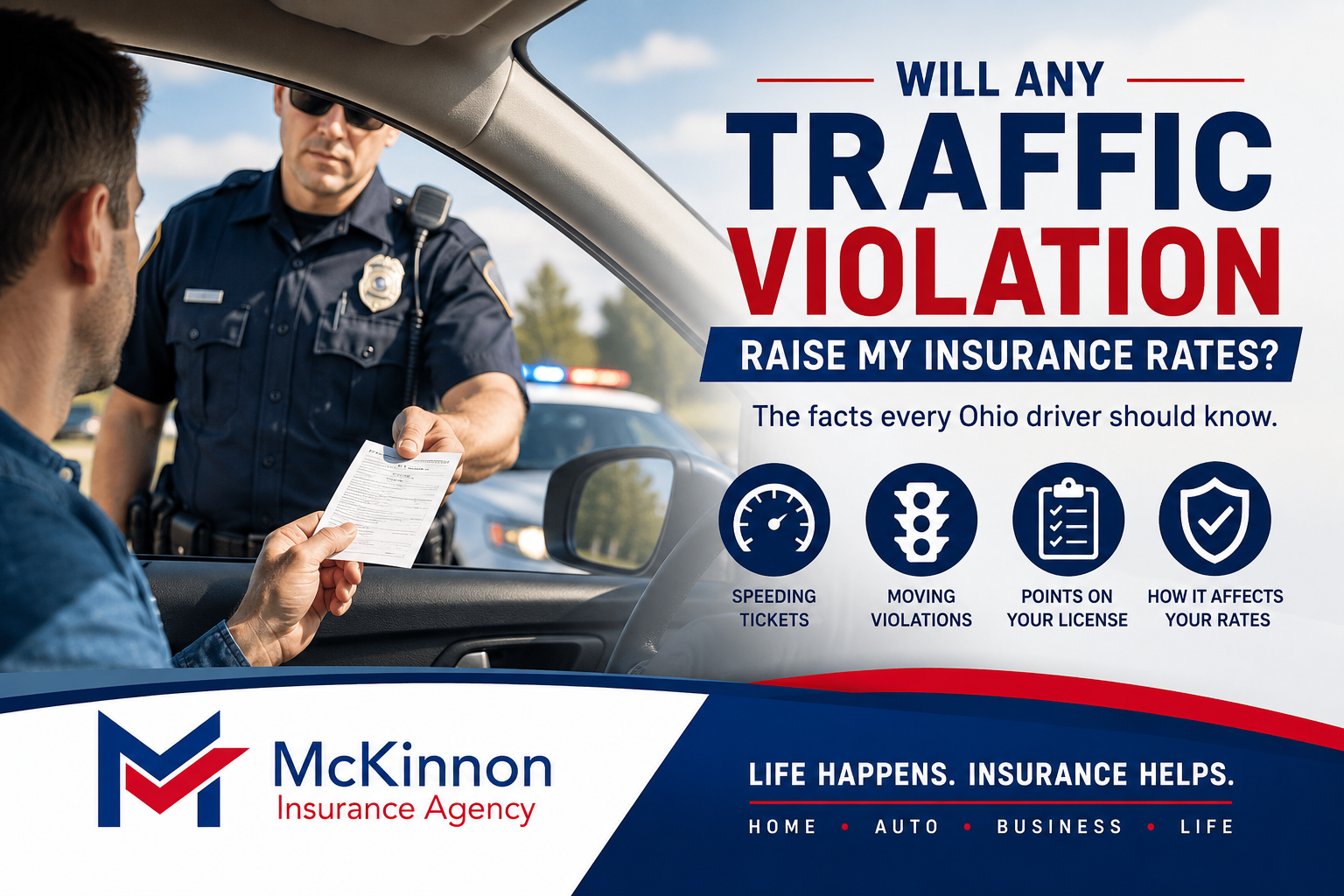
The truth about speeding tickets, moving violations, and what really affects your car insurance premiums in Ohio.
We’ve all been there.
You glance in your rearview mirror and suddenly see flashing blue lights.
A few minutes later, you’re pulling back onto the road with a citation in your hand and one question racing through your mind:
“Is my insurance going to go up now?”
It’s one of the most common questions we hear at McKinnon Insurance, and unfortunately, there’s no simple yes-or-no answer.
The good news? Not every traffic violation automatically means higher insurance rates.
Whether it’s a speeding ticket, running a stop sign, or another moving violation, insurance companies look at several factors before deciding if your auto insurance premium should change.
Here’s what every Ohio driver should know.
Does Every Traffic Ticket Raise Your Insurance Rates?
The short answer is no.
Receiving a traffic citation doesn’t automatically mean your insurance company will increase your premium.
Insurance companies evaluate risk differently, and every carrier has its own underwriting guidelines. Some companies may overlook a minor first-time violation, while others may consider it when your policy renews.
Several factors determine whether your rates may increase, including:
Your driving record is only one part of the overall picture. Your coverage choices, discounts, vehicle, location, and other rating factors may also affect what you pay. Our guide to car insurance discounts you might be missing explains several opportunities that may help eligible drivers lower their premiums.
- The type of violation
- How serious the offense was
- Your overall driving history
- How many violations you’ve had in recent years
- Whether the violation resulted in an accident
- The insurance company you have
This is one reason why shopping your insurance periodically can make a significant difference after receiving a ticket.
Which Traffic Violations Are Most Likely to Increase Insurance Rates?
Not all violations carry the same weight.
Generally speaking, moving violations that indicate risky driving behavior are more likely to affect your premiums.
These commonly include:
Speeding Tickets
The faster you were traveling over the speed limit, the more likely it is your insurance company may view you as a higher-risk driver.
Reckless Driving
Reckless driving citations often result in larger premium increases because they involve behaviors considered dangerous to other motorists.
Distracted Driving
Ohio law prohibits drivers from using, holding, or physically supporting an electronic wireless communications device while operating a vehicle, subject to specific exceptions. Drivers can review the current requirements in Section 4511.204 of the Ohio Revised Code. A distracted-driving citation may also become part of the driving history an insurance company considers when evaluating risk
Running Red Lights or Stop Signs
Failing to obey traffic signals can increase your likelihood of future accidents, making these violations important to insurance companies.
DUI or OVI Convictions
Driving under the influence typically has one of the largest impacts on insurance premiums and may even affect your ability to obtain coverage through certain companies.
What About Parking Tickets or Equipment Violations?
Many drivers assume every ticket affects insurance.
Fortunately, that’s usually not the case.
Parking tickets, expired registration violations, or equipment issues like a broken taillight generally do not impact your auto insurance premiums because they aren’t considered moving violations.
Insurance companies are primarily concerned with violations that suggest an increased likelihood of future accidents.
Does One Ticket Mean Your Rates Will Skyrocket?
Not necessarily.
If you’ve maintained a clean driving record for years and receive one minor speeding ticket, your insurance company may not increase your premium significantly—or at all.
Many insurers reward long-term safe drivers with:
Maintaining a clean record may also help you remain eligible for certain discounts. Learn more in our guide to 10 car insurance discounts you might be missing.
- Safe driver discounts
- Accident-free discounts
- Loyalty programs
- Good driving forgiveness programs
While these programs vary by company, they often help reduce the impact of an isolated violation.
However, multiple violations within a short period can tell a very different story.
Insurance companies pay close attention to patterns.
One ticket may be viewed as a mistake.
Several tickets may indicate increased driving risk.
How Long Can a Traffic Violation Affect Insurance?
Most moving violations can influence insurance premiums for three to five years, although the exact timeframe varies depending on the insurance company and the severity of the violation.
Serious offenses, such as reckless driving or DUI convictions, may affect your rates much longer.
Ohio also uses a point system for certain traffic convictions. The Ohio BMV sends drivers a warning letter after they accumulate six points within a two-year period, while accumulating 12 points within two years can lead to a license suspension. Drivers can review the state’s Ohio BMV point and suspension information for additional details.
As time passes and you continue to maintain a clean driving record, the impact of older violations generally becomes less significant.
Can Switching Insurance Companies Help?
Absolutely.
One of the biggest misconceptions we hear is that every insurance company charges the same after a traffic violation.
They don’t.
One company may increase premiums substantially after a speeding ticket, while another may view the exact same violation much more favorably.
That is one of the advantages of working with a local insurance agency that understands your driving history, coverage needs, and available options. Before changing policies based solely on price, it is important to compare deductibles, liability limits, optional coverages, and exclusions—not just the final premium. Our Ohio auto insurance page explains the types of coverage drivers should consider.
Instead of relying on a single company, we can compare multiple carriers to see which one offers the best combination of coverage, service, and price based on your individual situation.
A ticket doesn’t automatically mean you’re stuck paying higher premiums forever.
Tips to Keep Your Insurance Costs Lower
While no one can erase a traffic ticket overnight, there are several ways to help minimize future insurance costs.
- Practice defensive driving.
- Avoid additional moving violations.
- Ask about car insurance discounts you may be missing, including safe-driver, multi-policy, and other available discounts..
- Bundle your home and auto insurance when possible.
- Review your coverage every year to ensure you’re receiving the best value.
Small improvements today can save hundreds of dollars over the life of your policy.
Frequently Asked Questions
Will one speeding ticket automatically raise my insurance?
Not always. Some insurance companies may not increase rates for a first minor speeding violation, especially if you have an otherwise clean driving record.
Do parking tickets affect insurance?
Generally, no. Parking tickets and most non-moving violations do not impact insurance premiums.
Will my insurance company find out about my ticket?
In many cases, yes. Insurance companies may review motor vehicle records when underwriting or renewing a policy. Ohio drivers can also obtain copies of certain records through the Ohio BMV’s motor vehicle records service.
How long do speeding tickets affect insurance?
Most violations can impact premiums for three to five years, depending on the insurance company and the type of violation.
Should I shop for new insurance after receiving a ticket?
It can be a smart idea. Different insurance companies evaluate driving records differently, so comparing quotes may help you find better rates.
Do points on my Ohio driver’s license automatically determine my insurance rate?
Not necessarily. Ohio’s license-point system and an insurance company’s rating system are related to the same driving violations, but they are not identical. Insurers may evaluate the type, severity, frequency, and age of violations rather than simply using your total BMV point count. Drivers who accumulate at least two but fewer than 12 points may qualify to complete an approved remedial driving course for a two-point credit, although the course does not remove the original convictions from the driving record. Learn more through the Ohio BMV’s limited driving privileges and remedial course information.
Experience Matters
At McKinnon Insurance, we help Ohio drivers compare coverage from multiple top-rated insurance companies every day.
One of the biggest myths we hear is that every insurance company treats traffic violations the same.
They don’t.
Because every carrier has different underwriting guidelines, a ticket that results in a large increase with one company may have a much smaller impact with another. Traffic violations can become especially concerning when a new driver is involved. Parents may also find our guide, My Teen Driver Was in an Accident—What Should I Do?, helpful when preparing young drivers for what happens after a crash.
Our job is to help you understand your options—not just sell you a policy.
Life Happens. Insurance Helps.
A traffic ticket doesn’t automatically mean you’ll be paying dramatically higher insurance rates for years to come.
The severity of the violation, your driving history, and—most importantly—the insurance company you’re with all play a role.
If you recently received a traffic citation or want to understand how your driving record may affect your coverage, contact McKinnon Insurance for an auto-insurance review. We will help you review your current coverage, available discounts, and the options that fit your situation.
After all…
Life Happens. Insurance Helps.


Leave a Reply